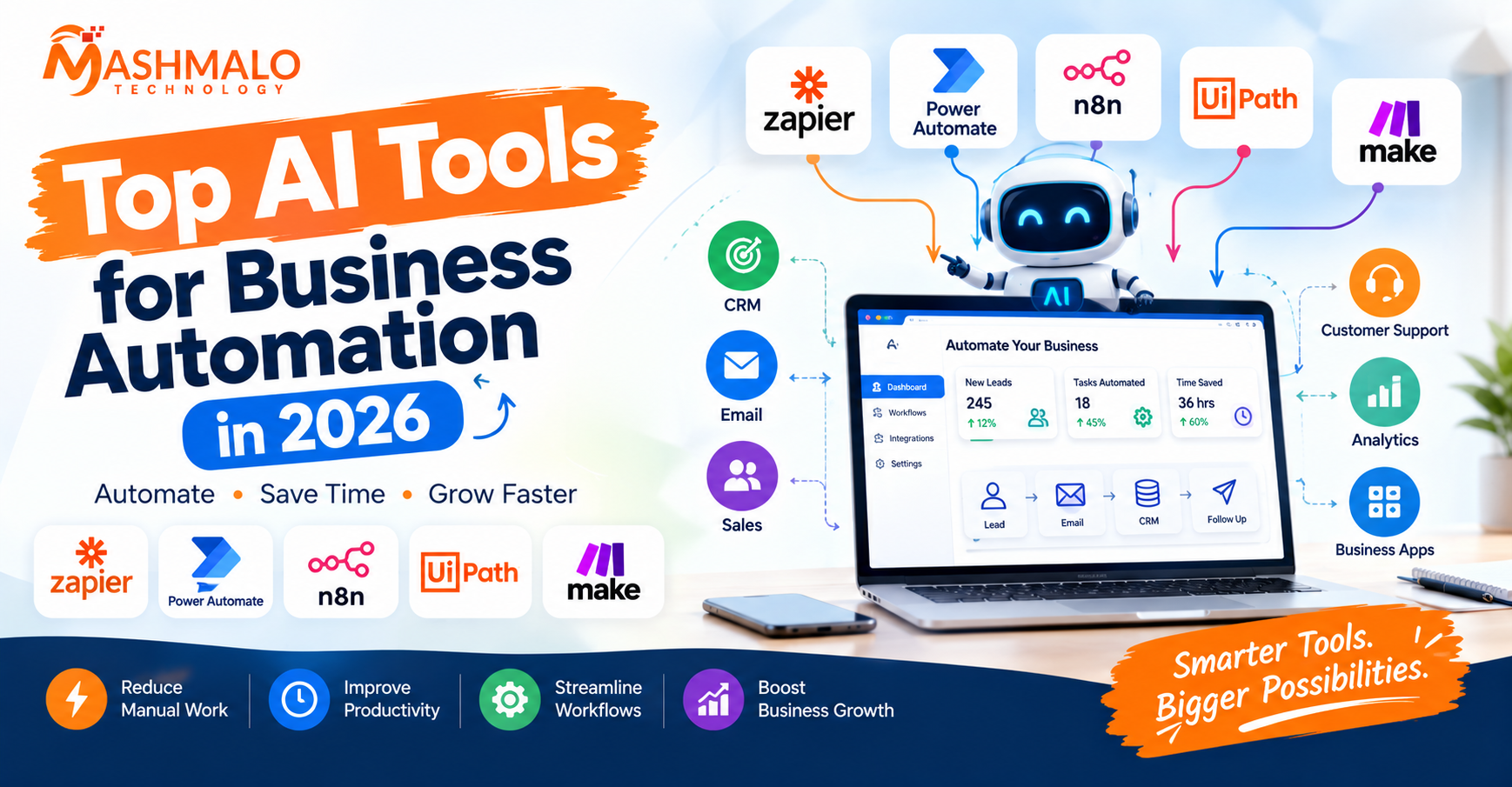
Top AI Tools for Business Automation in 2026
Artificial Intelligence is changing the way businesses manage their daily operations. In 2026, AI is no longer limited to chatbots and content generation. Businesses can now use AI automation tools to connect different applications, manage repetitive tasks, process information, support customers, and build intelligent workflows.
AI-powered automation can help small businesses, startups, agencies, and large companies reduce manual work and spend more time on important business activities.
Here are some of the top AI tools for business automation in 2026.
1. Zapier
Zapier is one of the popular platforms for connecting business applications and automating workflows. Its AI features can help users create and manage automations using natural-language instructions. Zapier supports thousands of app integrations, making it useful for marketing, sales, customer management, notifications, and other repetitive workflows.
Common uses:
- Lead management
- Email automation
- Customer notifications
- Marketing workflows
- Data transfer between apps
2. Microsoft Power Automate
Microsoft Power Automate is useful for businesses already working with Microsoft products. It can automate processes across Microsoft 365 and other connected services. Microsoft also provides AI-agent capabilities that can use connectors, workflows, MCP servers, and computer-use tools.
Common uses:
- Automating approval processes
- Managing documents
- Email and notification workflows
- Data processing
- Microsoft 365 automation
3. n8n
n8n is a flexible workflow automation platform that is particularly useful for technical teams. It supports self-hosting, API connections, custom logic, and AI-powered workflows.
Common uses:
- AI workflows
- API automation
- Data processing
- CRM automation
- Custom business workflows
4. UiPath
UiPath combines AI agents, robotic process automation (RPA), API workflows, and applications. It can be especially useful when businesses need to automate processes involving older software or interfaces that do not provide modern APIs.
Common uses:
- Data entry automation
- Invoice processing
- Legacy software automation
- Repetitive office tasks
- Enterprise workflows
5. Make
Make provides visual workflow automation, allowing businesses to connect applications and build multi-step processes. It can be used for marketing, sales, customer management, data processing, and other workflows.
Why Should Businesses Use AI Automation?
AI automation can reduce repetitive manual work and help teams create consistent processes. For example, when a customer submits a website enquiry, an automated workflow could save the information, notify the sales team, send a confirmation message, and add the lead to a CRM.
This allows employees to focus more on customer service, strategy, sales, and creative work.
Conclusion
AI automation is becoming an important part of modern business operations. Tools such as Zapier, Microsoft Power Automate, n8n, UiPath, and Make provide different approaches to workflow automation, from simple no-code processes to advanced technical and enterprise workflows.
Before choosing a tool, businesses should consider their existing software, workflow complexity, technical requirements, data needs, and budget. The right automation setup can help a business reduce repetitive work and build more efficient digital processes.